



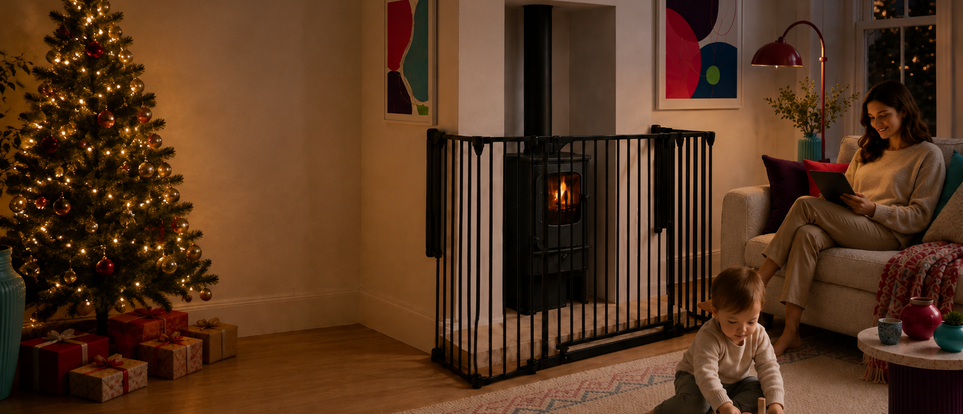
Choosing the right baby fireguard starts with the fireplace itself.
Every hearth is different. Some are wide and shallow, others project well into the room, and corner stoves or unusual chimney breasts may need a completely different layout.
The key is to protect the whole fireplace area, not simply the flames.
View our full Baby Fireguard range:
https://www.babasafe.ie/child-safety-products/baby-fireguards-ireland.html
1. Take three measurements first
Measure in centimetres:
- The full width of your hearth
- The depth of your hearth
- The distance from the heat source to the outer edge of the hearth
The first two measurements help determine the size and shape of guard you need.
The third helps you work out how much space will remain between the guard and the actual stove or fire.
Measure the whole hearth — not just the fire
A fireplace hearth can be a hazard even when the fire is not lit.
Stone, marble, granite and tiled hearths are hard, often raised and can have sharp corners at exactly the height where a crawling or newly walking child may fall.
Where possible, your fireguard should therefore sit outside the complete hearth.
2. Work out the shape you actually need
A typical BabaSafe MultiFit installation uses five panels:
Three across the front
and
one returning towards the wall on each side.
The centre section is normally the 90 cm walkthrough gate.
For example:
30 cm panel + 90 cm gate + 30 cm panel
gives a nominal front width of 150 cm.
The remaining panels then form the two sides.
But not every fireplace needs this layout.
Some fireplaces only need three panels
Corner stoves can often be protected using a three-panel configuration, particularly where the walls already enclose part of the hearth.
If the stove or hearth is positioned into a corner, there may be no reason to build a conventional five-panel surround.
The same basic rules still apply:
- protect the complete exposed hearth
- keep the child away from the fire or stove
- maintain suitable distance from the heat source
- make sure both ends have suitable wall-fixing positions
Hearth running into a corner? An L-shaped guard may work
Some hearths run directly into the corner of a room.
In this case, an L-shaped fireguard may be far neater than a conventional rectangular arrangement.
The exposed sides can be protected while the room walls form the remainder of the protected area.
Other installations may work better with an angled or trapezoid-style layout.
The important point is:
Design the fireguard around the area that needs protecting rather than forcing every fireplace into the same shape.
3. Total panel length is not enough
Do not choose a fireguard simply because the total combined length of all the panels appears to match the perimeter of your hearth.
The panels must be the right lengths in the right positions.
Check separately:
- the required front width
- the left-hand depth
- the right-hand depth
- where the wall brackets will actually be fitted
You can have more than enough total panel length and still find that the front is too narrow or that one of the side panels cannot reach the wall.
For a modular fireguard, the geometry matters more than the total perimeter.
4. Choose the configuration that best matches your hearth
For the neatest fit, start with the BabaSafe configuration whose width and depth most closely match the area you need to protect.
On a normal five-panel setup:
Three panels make up the front width.
One panel on each side makes up the depth.
But corner stoves, L-shaped hearths and unusual fireplaces may need a different arrangement altogether.
It is generally better for the guard to sit slightly outside the hearth than to leave part of the hard hearth accessible.
At the same time, do not concentrate so heavily on getting a neat fit around the hearth that you forget about the actual fire or stove.
Heat clearance matters too.
5. Use the adjustable angles
The joints between BabaSafe panels can be rotated and locked at different angles.
This gives you considerable flexibility around:
- uneven hearths
- wide chimney breasts
- corner fireplaces
- different left and right depths
- unusual wall-fixing positions
- installations where the nominal width is slightly too large
Angling the panels changes the straight-line distance between the two fixing points without changing the actual panel lengths.
Angles can also improve stability
This is particularly useful on wider fireguards.
A very wide guard arranged in one perfectly straight line can allow more sideways flex.
Creating some shape by angling the outer sections slightly can give the guard a more stable footprint.
So the straightest-looking arrangement is not always the best one.
A slight angle can sometimes improve both the fit and the stability.
6. Check the distance from the fire or stove
Once the dimensions work, think about heat.
There are two things to consider.
Can your child reach the heat source?
Your child must not be able to reach:
- through the vertical bars
- around either side
- over the guard
- towards a projecting stove from an angle
Children vary in height, reach and ingenuity, so there is no single measurement that can guarantee suitability for every child.
Look at the finished arrangement from your child's position.
If they can reach the fire, stove or another dangerously hot surface from any direction, increase the protected area.
Can the fireguard itself become too hot?
The guard is made from metal and will absorb radiant heat.
As a precautionary starting point, BabaSafe instructions recommend approximately:
75 cm from a stove
90 cm from an open fire
These are guidelines rather than guarantees.
Every fire behaves differently.
A large stove operating strongly for several hours may produce considerably more radiant heat than a smaller appliance running gently.
Some installations may therefore need more clearance, while other lower-heat setups may remain safe at a shorter distance.
When first using the fire with the guard fitted, check the front and side panels during normal use.
If the guard becomes excessively hot, stop using that configuration and increase the distance from the heat source.
Always follow the appliance manufacturer's own instructions as well.
If the fire is never lit
Some families simply want to keep children away from the hearth, fireplace opening, ash, soot or stove body.
If the fire genuinely will not be used, heat clearance is no longer the main consideration and you can concentrate on obtaining a neat protective fit around the physical hazards.
7. Don't forget the side clearance
It is easy to focus entirely on the width across the front.
But with many stoves, the side distances matter just as much.
A stove projecting into the room can radiate significant heat sideways as well as forwards.
Your side panels therefore need to be long enough to:
- clear the hearth
- prevent access from either side
- maintain suitable distance from the heat source
- reach the intended wall-bracket positions
This is particularly important with freestanding or partially recessed stoves.
It is also another reason why total perimeter alone is not enough.
8. Allow for the wall brackets
The wall brackets are part of the finished layout and need to be considered when measuring.
They add approximately 5 cm at the wall connection.
Depending on the chimney breast and available wall space, they can normally be fitted either:
- on the front face of the chimney breast
- or rotated around the corner onto the side of the chimney breast
This is especially useful where the hearth extends almost to the edge of the chimney breast.
If the brackets need to be fitted around the side, make sure the side panels are long enough to reach those fixing points.
Also check for:
- skirting boards
- pipes
- gas valves
- sockets
- decorative mouldings
- unusual wall shapes
Inglenook fireplaces
Do not plan to mount the wall brackets deep inside an inglenook or recessed fireplace opening.
Heat can become concentrated inside the recess and may make those fixing positions unsuitable.
The guard should normally be positioned outside the inglenook, with the wall brackets away from the concentrated heat.
If you have an unusual inglenook or deeply recessed stove, use our sizing-help service and send us photographs and measurements before choosing your configuration:
https://www.babasafe.ie/get-sizing-help-ireland
9. Some movement is normal
The BabaSafe MultiFit is an articulated multi-panel barrier.
That flexibility is what allows the panels to create different shapes, but it also means that some movement is normal.
Movement may be more noticeable when:
- the guard is very wide
- several panels are positioned completely straight
- there is no raised hearth behind the guard
- the guard extends much further than the hearth
- persistent pressure is applied from the side
The hearth often helps naturally
On many installations, the raised hearth sits behind the lower part of the guard and naturally restricts movement.
Where there is no raised hearth, or the guard extends substantially beyond it, lateral movement may become more noticeable.
Sideways pressure creates more movement
Pressure directly towards the fireplace is generally resisted better by the shape of the guard and, where present, the hearth behind it.
Persistent sideways pressure can create more movement because the articulated joints are being encouraged to change angle.
Some movement does not automatically mean the guard is incorrectly fitted.
What matters is that:
- both ends remain securely fixed
- the guard remains attached to its brackets
- the barrier stays correctly positioned
- movement cannot allow the child to reach the protected area
Improve stability through the shape
Before assuming anything is wrong, look at the configuration.
Adding a slight angle to wider sections can often create a more stable shape than one long straight run.
Floor brackets are available
For the relatively small number of installations where additional stability is needed, BabaSafe floor brackets are available.
They can be particularly useful where:
- there is no raised hearth
- the guard is unusually wide
- the guard extends well beyond the hearth
- additional control of sideways movement is required
Floor brackets may not suit every flooring type, so they are an additional option rather than something required with every installation.
10. Remember the hearth itself
The fire is only one part of fireplace safety.
A raised stone or tiled hearth can be one of the hardest surfaces in the room and can have sharp corners and projecting edges at exactly the wrong height for a young child.
That is why we recommend protecting the whole hearth area, rather than placing a guard tightly around the flames alone.
The aim is to prevent access to:
- the heat source
- hard hearth edges
- sharp corners
- ash and soot
- the fireplace opening itself
11. Height, climbing and access
The BabaSafe MultiFit Fireguard is approximately 76 cm high.
Keep stools, chairs, toy boxes and other objects away from the guard so they cannot become climbing aids.
Children develop quickly, so review the installation as your child becomes taller and more mobile.
The MultiFit also includes a walkthrough gate for adult access to the fireplace.
After lighting, refuelling or cleaning the fire, always make sure the gate is fully closed and locked.
12. Easy to remove when the fireguard is not needed
A large fireguard does not have to stay in your living room all year.
The BabaSafe MultiFit can be quickly released from its wall brackets without dismantling every individual panel.
Once removed:
- loosen or unlock the panel angles
- fold the guard into a compact shape
- store it away
The small wall fittings can remain in place.
When you need the guard again, simply unfold it, reset the angles and mount it back onto the brackets.
This is particularly useful during warmer months when the fireplace may not be used for long periods.
Some unusual configurations may require a little more dismantling to fold into their smallest storage size, but the system is designed to make removal and storage straightforward.
13. Need a larger or custom configuration?
Because the MultiFit is modular, additional panels can be used to increase the width, depth or overall protected area.
This is useful for:
- large hearths
- freestanding stoves
- corner fireplaces
- L-shaped layouts
- unusually deep hearths
- asymmetric installations
- configurations where extra heat clearance is required
View our full Baby Fireguard range, extensions and configurable options here:
https://www.babasafe.ie/child-safety-products/baby-fireguards-ireland.html
Before ordering, check these points
Make sure you know:
- your complete hearth width
- the depth required on each side
- the distance from the hearth edge to the heat source
- the front panel width required
- where the wall brackets will be fitted
- whether a five-panel, three-panel or L-shaped arrangement works best
- whether the panels need to be angled for fit or stability
- whether your child could reach the heat source from any direction
- whether your particular installation may benefit from floor brackets
And most importantly:
Do not choose a fireguard simply because the total panel length appears sufficient.
The width, depth, angles and fixing positions all need to work together.
Unsure which size you need?
If your fireplace is unusual, don't guess.
Send us your measurements and a photograph of the complete fireplace area, and we can review the layout and recommend a suitable BabaSafe MultiFit configuration.
Submit your photo and measurements here:
https://www.babasafe.ie/get-sizing-help-ireland
You can also browse the complete BabaSafe Baby Fireguard range here:
https://www.babasafe.ie/child-safety-products/baby-fireguards-ireland.html
The principles are simple:
Protect the complete hearth.
Allow suitable clearance from the heat source.
Choose the correct geometry — not simply enough total panel length.
And if you're unsure, send us a photo and measurements and we'll help work out the layout.