



When you are buying a baby gate, it is tempting to judge one by fairly simple things.
Does it feel heavy?
Does the catch look strong?
Does it seem difficult for a toddler to open?
Does the packaging describe it as a baby gate?
Those things may influence your decision, but they do not tell you whether the product has actually been assessed as a child safety barrier.
That is the purpose of EN 1930.
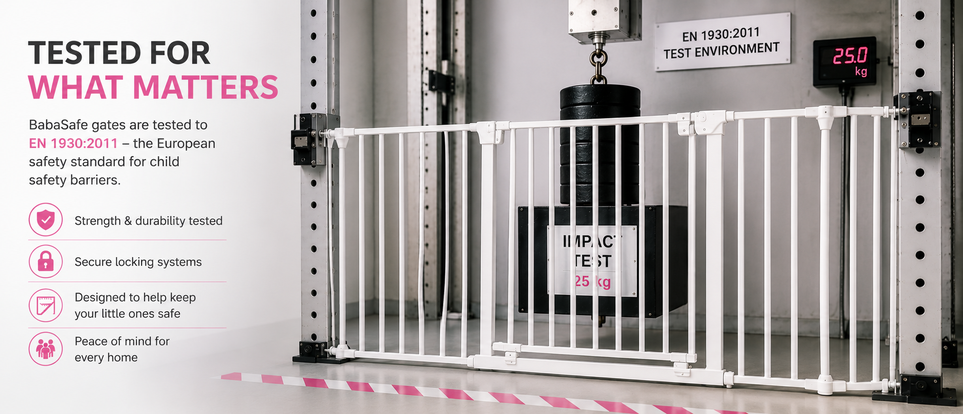
EN 1930 is the recognised European standard covering child safety barriers intended for domestic indoor use. It specifies safety requirements and testing methods for barriers designed to prevent young children from passing through an opening within the home.
In Ireland, you will normally see the standard referred to as:
I.S. EN 1930:2011
In the UK, the same European standard is adopted as:
BS EN 1930:2011
The letters are different because the standard has been adopted through different national standards bodies, but both originate from the same European EN 1930 standard.
For parents, the important point is much simpler:
A product looking like a baby gate is not the same thing as a product being designed and tested as a child safety barrier.
What is EN 1930 intended to cover?
EN 1930 relates to safety barriers intended for domestic indoor use and designed to restrict the movement of young children.
Typically, this means barriers used around areas such as:
- doorways
- stairs
- rooms that need to be restricted
- larger openings
- configurable areas within the home
The standard is primarily concerned with barriers intended for children up to approximately 24 months of age.
It does not tell manufacturers that every baby gate must look identical.
Instead, it establishes safety requirements and methods of testing different designs.
That allows a conventional stair gate, for example, to look very different from a large configurable barrier while still being assessed against relevant child-safety requirements.
Why is a recognised standard important?
Babies and toddlers do not use products gently.
A child safety barrier may be:
- pushed
- pulled
- shaken
- leaned against
- repeatedly opened and closed
- investigated from every possible angle
A gate can look extremely substantial in a photograph and still have weaknesses that are not obvious to the customer.
A recognised standard provides a way of assessing safety using defined tests and requirements, rather than relying on appearance or a manufacturer's opinion that a product is strong enough.
That is the real value of EN 1930.
What areas are considered when a child barrier is tested?
EN 1930 examines considerably more than whether a gate can withstand somebody pushing against it.
Strength and construction
The barrier has to maintain its integrity during the relevant tests.
The frame, joints, fixings and other structural components all contribute to whether the barrier continues performing its intended function.
The locking system
A locking mechanism has two competing jobs.
It needs to be practical enough for an adult to operate, while being sufficiently difficult for a young child to accidentally release.
The operation and security of the opening system are therefore an important part of child-barrier design.
Openings and potential entrapment
Children put fingers, hands, arms and heads into remarkably small or unusual spaces.
Gaps and openings within a barrier therefore matter.
The standard considers dimensions and construction features intended to reduce foreseeable trapping and entrapment hazards.
Climbing and footholds
A barrier should not unintentionally provide a convenient ladder.
Height and accessible footholds are therefore important considerations.
This is one of the reasons the shape and orientation of bars can matter considerably on a product intended for children.
Sharp areas and projections
A barrier designed to prevent one accident should not create another.
Accessible edges, corners, projections and similar construction details are therefore also considered.
Repeated operation and impact
Baby gates are working products.
They are opened and closed repeatedly and subjected to forces throughout their life.
Testing therefore examines how the product performs under specified loads, impacts and repeated-use conditions.
Instructions and product information
Correct fitting forms part of the safety system.
A good barrier therefore also requires suitable instructions, markings and information explaining how and where the product should be used.
A dog gate is not necessarily a baby gate
This is an area where parents need to be particularly careful.
There are many excellent pet gates and dog barriers available.
But a product designed to contain a dog is not automatically designed to protect a young child.
Unless the manufacturer specifically states that the gate is also intended as a child safety barrier and has been tested to the relevant child-safety requirements, you should not simply assume that it is equivalent to a baby gate.
Pet barriers can sometimes contain features such as:
- horizontal rails
- diamond or lattice patterns
- large openings
- structures providing potential footholds
- simple latches designed primarily for pet containment
A design may be perfectly suitable for its intended purpose while being inappropriate for a toddler.
There is an important distinction between:
“This barrier will stop my dog leaving the room.”
and
“This product has been designed as a child safety barrier.”
A gate capable of containing a large dog can certainly look impressive.
But strength alone does not make something a safe baby gate.
Take care with traditional fireplace guards as well
The same principle applies to fireplace products.
Traditional cage-style fireguards have been used in Irish and British homes for generations.
Some are designed principally to keep people away from a fire or contain sparks, and there are separate standards relating to domestic fireguards.
For example, in Britain BS 8423 relates specifically to fireguards for domestic fires and heating appliances.
That is not the same standard as EN 1930, which deals with child safety barriers.
A conventional fireplace cage should therefore not automatically be treated as an EN 1930 child barrier simply because:
- it surrounds a fire
- it is made from metal
- it looks strong
- photographs of babies appear in the advertising
Traditional designs may sometimes incorporate horizontal sections, mesh, freestanding structures or other features that differ considerably from a purpose-designed child safety barrier.
If you are buying specifically to protect a baby or toddler, check the actual intended use and the standard the manufacturer says the product has been tested against.
A picture of a child beside a product is marketing.
It is not evidence of safety testing.
Should a compliant multi-panel gate feel completely rigid?
Not necessarily.
This is particularly important with large configurable barriers.
A multi-panel gate uses articulated joints because those joints allow individual sections to be positioned at different angles.
That flexibility makes it possible to configure a barrier around:
- large openings
- fireplaces
- corners
- awkward walls
- unusual room layouts
The consequence is that a large articulated barrier can naturally have some flex or movement.
It should not be confused with a solid welded frame.
Movement may become more noticeable when a barrier is particularly wide or when several sections are arranged in one long straight line.
Sideways pressure can also create more movement than pressure applied directly towards the protected area.
The important safety questions are whether:
- the barrier remains securely attached
- the wall fixings remain secure
- the configuration remains in the intended position
- movement could allow the child to access the protected area
With configurable systems, the actual shape of the barrier can also affect stability.
Slightly angling sections can create a more stable footprint than stretching a large number of articulated panels completely straight.
For certain unusual installations, additional floor supports may also be appropriate.
Pressure-fit and wall-mounted gates have different uses
EN 1930 does not mean every type of baby gate is suitable for every location.
A pressure-fit gate can be extremely convenient.
It is normally held between two surfaces using outward pressure and may avoid the need to drill into the walls.
A wall-mounted barrier is mechanically fixed into the surrounding structure.
Both types can have legitimate uses, but where you intend to install the barrier matters.
Particular care is needed around locations such as stairs, very wide openings and areas where substantial loads could be applied.
Always check the manufacturer's instructions to ensure the particular product is suitable for the location you intend to protect.
The fact that a gate physically fits into an opening does not automatically mean that it is the correct gate for that opening.
What about using a child safety barrier around a fireplace?
Using a configurable child barrier as a baby fireguard introduces another layer of considerations.
The barrier still needs to perform its main function:
keeping the child out of the protected area.
However, a working fire or stove also introduces factors that are outside the simple question of whether the gate itself is a suitable child barrier.
You must consider:
- distance from the stove or open fire
- radiant heat
- whether the child could reach through the bars
- heat reaching the side panels
- projecting stoves
- the position of the hearth
- hard hearth edges and corners
- safe wall-fixing positions
The hearth deserves particular attention.
For a newly walking toddler, a raised granite, stone, marble or tiled hearth can be one of the hardest collision surfaces in the room.
A correctly sized baby fireguard should therefore generally create a protected area around the whole fireplace zone, rather than simply placing a narrow barrier immediately in front of the flame.
You can view BabaSafe baby fireguards and configurable options here:
https://www.babasafe.ie/child-safety-products/baby-fireguards-ireland.html
Does EN 1930 mean an installation cannot go wrong?
No.
This is an important distinction.
A recognised safety standard provides requirements against which the product can be assessed.
The customer still needs to install and use that product correctly.
Problems can be introduced by:
- unsuitable fixings
- weak or unsuitable mounting surfaces
- incorrect positioning
- brackets installed incorrectly
- using the wrong type of gate for the location
- leaving the walkthrough gate open
- placing furniture beside the barrier that provides a climbing aid
- allowing the child to reach the hazard through or around the barrier
- ignoring the manufacturer's installation instructions
A tested baby gate is an important part of creating a safer environment.
It does not make installation irrelevant.
Questions worth asking before buying a baby gate
Rather than simply choosing the gate that looks strongest, take a few minutes to check what you are actually buying.
Ask:
- Is this product specifically intended for young children?
- Does the manufacturer state the child safety standard against which it has been tested?
- Are proper installation instructions supplied?
- Is the fixing system appropriate for my intended location?
- Does the design avoid obvious footholds or climbing features?
- Is the locking mechanism designed with young children in mind?
- Can I obtain replacement parts or technical support if needed?
- Can I clearly identify the manufacturer or responsible supplier?
Be particularly cautious when substituting something primarily sold as a dog gate, pet barrier or conventional fireplace cage for a product designed specifically as a child safety barrier.
They are not automatically interchangeable.
EN 1930 in Ireland, Britain and Europe
The different names can make this more confusing than it needs to be.
The European standard is:
EN 1930:2011
Its Irish adoption is:
I.S. EN 1930:2011
Its British adoption is:
BS EN 1930:2011
These are not three unrelated baby-gate standards.
They represent national publication of the same underlying European standard.
That is useful for Irish customers buying products throughout Europe or from British retailers, because you may encounter several versions of the designation.
The important part to recognise is EN 1930.
Is a new version of EN 1930 coming?
Safety standards are periodically reviewed as product designs, testing knowledge and safety expectations evolve.
As of 2026, EN 1930:2011 remains the current published edition, while work on a revised European standard is underway.
A draft revision entered the standards-development and consultation process during 2026, with the current development timetable pointing towards a possible new publication during 2027.
Standards timetables can change before final publication, so manufacturers and suppliers need to follow the development process rather than treating a proposed date as guaranteed.
For parents buying a gate today, however, there is no reason to wait.
The relevant question is whether the product has been designed and tested appropriately against the current applicable requirements.
Why BabaSafe takes the standard seriously
BabaSafe barriers intended for child-safety applications are designed with the applicable requirements of EN 1930:2011 in mind.
For Irish customers that standard is encountered as I.S. EN 1930:2011.
The importance of the standard is not simply the number printed on a specification sheet.
It represents detailed consideration of things parents may never think to examine themselves:
strength, gaps, footholds, locking systems, construction, fixings, durability and the way the barrier behaves during use.
That is why choosing a purpose-designed child safety product matters.
The simple takeaway
Parents do not need to become experts in European standards.
That responsibility belongs primarily with manufacturers, testing organisations and suppliers.
But understanding the basics helps you distinguish between products that merely look like safety barriers and those actually intended for use around young children.
Remember:
A dog gate is not automatically a baby gate.
A traditional fireplace guard is not automatically an EN 1930 child safety barrier.
A strong-looking product is not necessarily a tested product.
And perhaps most importantly:
Marketing photographs showing babies do not tell you what standard a product has been tested to.
When the purpose of a barrier is protecting a young child, look beyond the photograph and check what you are actually buying.