



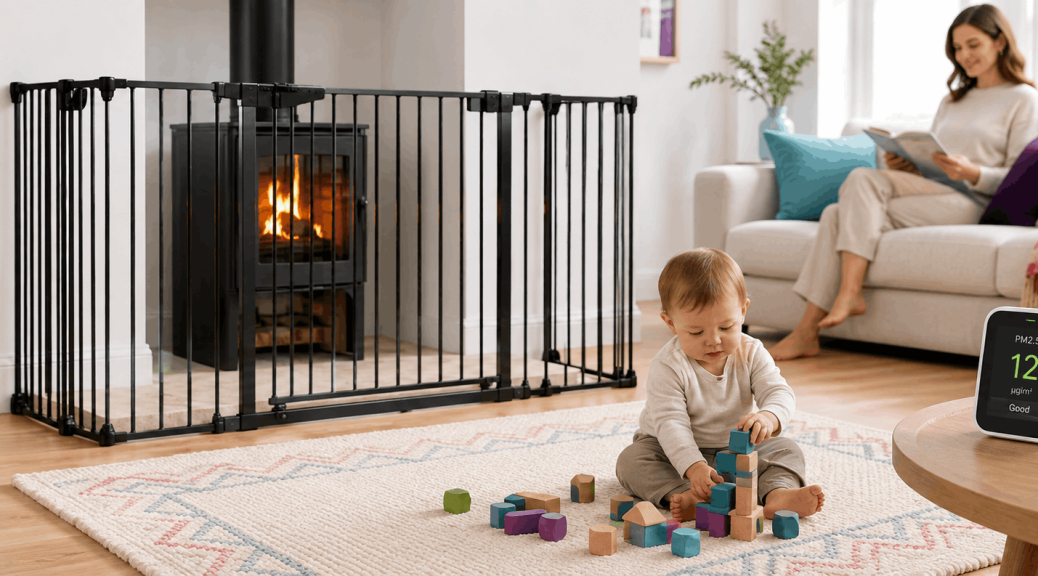
You’ve protected your baby from the fire — but what about the air?
When parents think about babyproofing a fireplace, the dangers are easy to see.
There is the flame itself. A hot stove door. The hard edges of the hearth. Sparks from an open fire. And, of course, a curious baby who wants to investigate absolutely everything.
Installing a properly fitted baby fireguard is an important first step. It creates a physical barrier between your child and the obvious hazards around an open fire or stove.
But there is another part of fireplace safety that receives much less attention.
The air inside the room.
When we burn wood, coal, peat or other solid fuels, we create gases and extremely small particles. Most of them should leave the house through the chimney or flue, but combustion can also affect the air inside the home.
And unlike a flame or a hot stove, you cannot necessarily see the danger.
For families using open fires and solid-fuel stoves in Ireland, it is worth understanding what is happening beyond the fireguard.
Why the air from a fire matters
One of the main pollutants associated with burning solid fuel is fine particulate matter, commonly called PM2.5.
These particles are incredibly small. They can penetrate deep into the lungs, and the Irish Environmental Protection Agency links exposure to fine particulate matter with respiratory and cardiovascular health effects.
This is particularly relevant in Ireland because home heating remains an important source of particulate pollution.
The EPA states that the main source of fine particulate matter in Ireland is the burning of solid fuel for home heating. It specifically notes that burning fuel in stoves — and especially open fires — can result in unburnt particles travelling through the chimney or directly into the room where the fire is being used.
Ireland's 2024 State of the Environment Report makes the same point: burning coal, peat and wood in open fires and stoves can affect both outdoor and indoor air quality.
So this is not simply an outdoor pollution issue.
Some of the pollution produced by domestic fires can affect the people sitting in the same room.
Why babies and young children deserve particular attention
Poor air quality is not good for anyone, but babies and young children deserve a little extra consideration.
Their lungs and respiratory systems are still developing, and they can spend long periods inside the home during the winter months — often in the very room where the family fire or stove is burning.
There is also a simpler practical problem:
A baby cannot tell you that a room feels smoky, stuffy or uncomfortable.
This does not mean parents should become frightened of using a fireplace.
A well-maintained heating appliance in a properly ventilated home is very different from a smoky, poorly drawing fire.
The sensible approach is simply to treat air quality as another layer of child safety.
We already protect children from the heat source with a baby fireguard. It makes sense to pay some attention to the air around that heat source too.
Open fires, stoves and the Irish solid-fuel tradition
Open fires remain a familiar part of Irish homes, particularly in older properties.
Wood, coal, peat and manufactured fuels have all traditionally been used for home heating here. But from an air-quality perspective, not every form of solid-fuel heating performs equally well.
The Irish EPA places open fires towards the more polluting end of its home-heating spectrum and encourages movement towards cleaner forms of home heating where possible.
Irish research demonstrates why this matters.
An EPA-funded study examining winter air pollution in Killarney, Enniscorthy and Birr found that residential burning of peat, coal and wood was by far the largest source of PM2.5 pollution measured in those locations during winter.
An enclosed modern stove can generally control combustion better than a traditional open fireplace, but simply owning a stove does not make air-quality considerations disappear.
The installation, chimney, flue, ventilation, fuel and condition of the stove all matter.
The EPA has previously highlighted that emissions from stoves can vary depending on the quality of installation, choice of fuel, maintenance and how the appliance is operated.
So whether you have an old open fireplace or a modern wood-burning stove, good practice still matters.
Your chimney is part of the heating system
We tend to look at the fire.
But much of the important work is happening above it.
A chimney or flue needs to create sufficient draw to carry smoke and combustion gases safely away from the room.
When that draw is poor, smoke may escape into the living area rather than travelling cleanly upwards.
Sometimes the problem is obvious. You may see smoke coming back into the room when lighting the fire or adding another log.
Other warning signs can include:
- persistent smoky smells
- unusual soot staining around the fireplace
- difficulty getting the fire established
- a stove that regularly smokes when its door is opened
- noticeable changes in how the chimney normally draws
Chimneys can also become restricted by soot, deposits, debris or nests.
Irish Government fire-safety guidance recommends regular chimney cleaning and gives different suggested frequencies depending on the fuel and appliance being used. It also stresses the need for proper ventilation when using heating appliances.
The HSE similarly advises families to have their chimney cleaned regularly and to ensure smoke detectors and carbon monoxide alarms are working.
A chimney that has worked well for years should not simply be assumed to be problem-free forever.
If the behaviour of your fire changes, investigate why.
What you put on the fire matters too
Good combustion begins with suitable fuel.
Wet wood is particularly problematic because some of the fire's energy must first be used to drive moisture out of the timber. This makes it harder to achieve efficient combustion and can contribute to smoke and deposits within the chimney.
Irish EPA guidance advises against burning wet timber and recommends properly seasoned wood. It also warns that burning wet wood can contribute to tar and soot deposits within stoves and chimneys.
Ireland also has national Solid Fuel Regulations designed to reduce pollution from domestic heating fuels. These regulate fuels placed on the market, including requirements relating to smoke emissions and the moisture content of wood products.
For householders, the practical message is simpler:
Use the right fuel, keep wood properly dry and do not burn materials that were never intended to go into a domestic fireplace or stove.
Painted or treated timber, rubbish and inappropriate materials do not belong on the fire.
And allowing a wood fire to smoulder inefficiently for hours is not the same as achieving good, clean combustion.
Ventilation matters — even when you want to keep the heat in
Irish winters give us a very understandable instinct:
Shut the doors, shut the windows and keep every bit of heat inside.
But a fire needs air.
Combustion appliances must receive enough air to operate correctly, and the chimney needs the right conditions to establish proper draw.
This can become particularly relevant after renovating an older house.
New windows, additional insulation and draught-proofing can make a property considerably more airtight than it was when the original fireplace was installed.
Permanent vents provided for a stove or fireplace should therefore not simply be covered because they feel draughty.
Irish Government fire-safety guidance specifically advises ensuring there is proper ventilation in rooms using heating appliances.
Kitchen or bathroom extractor fans can also alter air pressure inside a property, so persistent problems with chimney draw are worth discussing with a competent professional rather than simply accepting them.
A warm house is important.
So is fresh air and correct combustion.
Keep babies warm — but don't overheat the room
A roaring stove can turn a sitting room into a very warm space surprisingly quickly.
That might feel wonderful to an adult coming in from an Irish January evening, but babies do not need tropical temperatures.
For sleeping babies, the HSE recommends a room temperature between 16°C and 20°C and advises that a baby should never be placed to sleep beside a radiator, heater or fire.
The HSE also specifically warns that overheating can increase the risk of cot death.
The practical lesson is not that your living room has to remain at exactly 18°C all evening.
It is simply to remember that warmer is not automatically better for a baby.
A basic digital room thermometer removes much of the guesswork.
And because fires and stoves produce strong localised heat, think about where your baby's cot, play mat, chair or play area is positioned relative to the appliance — even when a fireguard prevents direct access.
Carbon monoxide: a different invisible danger
Particulate pollution is not the same thing as carbon monoxide.
Carbon monoxide, or CO, is a poisonous gas produced when fuels such as wood, coal, oil or gas do not burn completely.
It has no smell or taste.
The HSE lists symptoms of carbon monoxide exposure including headache, dizziness, nausea, tiredness, confusion and breathing difficulties. Children are among the groups identified as being particularly vulnerable.
Problems can arise from badly installed or maintained appliances, blocked chimneys and flues, or inadequate ventilation.
That is why every home containing fuel-burning appliances should have appropriate carbon monoxide alarms.
The HSE recommends a CO alarm in each room containing an appliance that burns gas, oil, coal or wood, while stressing that an alarm is not a substitute for maintaining and servicing the appliance itself.
And remember:
A general indoor air-quality monitor is not a replacement for a carbon monoxide alarm.
CO deserves its own dedicated alarm.
Can an air-quality monitor tell you what is happening?
This is where modern technology can be useful.
Home air-quality monitors are increasingly affordable, and many can measure things such as:
- PM2.5
- carbon dioxide or CO₂
- temperature
- humidity
They are not medical instruments, and inexpensive consumer sensors should not be treated as perfectly accurate laboratory equipment.
But they can be useful for identifying patterns.
For example, you might notice that particulate levels rise when:
- you first light the fire
- you add another log
- you open a stove door
- the chimney is struggling to establish a draw
You may also discover that a room becomes hotter or more poorly ventilated than you realised.
For families particularly interested in indoor air quality, a PM2.5 monitor can therefore provide useful information about something that is otherwise difficult to see.
Think of it as an extra set of eyes.
Not a replacement for proper installation, maintenance or a carbon monoxide alarm.
A simple Irish fireplace safety routine
You do not need to turn your sitting room into a laboratory.
Most of this comes down to straightforward habits.
Protect against the physical danger.
Use a properly fitted baby fireguard to prevent children reaching flames, hot stove surfaces and the hearth.
Keep the chimney maintained.
Have it swept at suitable intervals for the appliance and fuel you use.
Burn appropriate fuel.
Use properly dried wood and approved fuels suitable for your fireplace or stove.
Keep required ventilation open.
Do not block permanent vents intended to supply combustion air.
Watch how your fire behaves.
Repeated smoke entering the room, unusual soot, persistent smells or deterioration in chimney draw deserve investigation.
Use smoke and carbon monoxide alarms.
Check them regularly and replace them according to the manufacturer's instructions.
Think about temperature.
Do not position a sleeping baby beside a fire or stove, and avoid overheating rooms used for sleep.
Consider monitoring the air.
A PM2.5 monitor is optional, but it can provide useful insight into how your fire affects indoor air quality.
Fireplaces can still be part of a safe family home
None of this means an Irish family with an open fire or stove should panic.
A fireplace can be warm, practical and one of the nicest features of a home.
The point is simply to think about fireplace safety in a slightly broader way.
We have become very good at recognising the things that can hurt a child immediately.
We see the flame.
We feel the heat.
We notice the hard hearth.
And fitting a fireguard for babies and young children is an obvious and sensible response.
Air quality is easier to forget because most of the time we cannot see it.
But good fuel, good ventilation, a clean chimney, a properly installed appliance, sensible temperatures and working carbon monoxide alarms are all part of the same job:
creating a warm home that is also a safer home.
Protect little hands from the fire.
And give some thought to the air those little lungs are breathing too.
Irish sources and further reading
This article draws principally on guidance and research from the Environmental Protection Agency (EPA Ireland) regarding particulate pollution and domestic solid-fuel heating, including Ireland's 2024 State of the Environment Report and EPA research into residential solid-fuel pollution.
Baby temperature and carbon monoxide guidance is based on information published by the Health Service Executive (HSE).
Fireplace, ventilation and chimney-maintenance recommendations also draw on Irish Government fire-safety guidance.